Karl and I lived in the Republic of Ireland for three years in the 1980s. As mentioned before, Karl bought me my first professional camera for my birthday the first year there, and started me on my sometimes career. That Nikon FE went everywhere with me, with its manual controls and film canisters.
London weekends became one of our favorite short get-aways. During a cool, rainy day on one of those trips, I took this shot in Hyde Park. Remember, this was transparency film, slides, and Karl scanned this a few years ago as we realized that the slides wouldn't last forever.
The chestnut vendor stood with his lit cigarette, hardly noticing the light rain. As I look at this shot now, I realize that I should have shot from a higher angle, so his inclined head stood out against the grass background rather than the street. Since street photography means not posed, and that angle might have alerted him to my camera, it likely would not have worked at all had I tried it. This remains one of my favorite shots of London as it was in the 1980s.
Karl and Kathleen Nichter Photography
This blog began in 2009, about a year after we started our photography business. People attending our photo exhibits, or our hikes and workshops, asked for details on where we traveled for photography. As naturalists we usually kept a field journal, so we used that as a basis for Field Notes.
In Summer, 2014 we took a break from the blog because our business, and lives were changing. In January 2015 the blog restarted with an expanded theme. It now contains photography, notes, and articles from all of our travels and all of our photography, not just nature themed. The posts prior to 2014 have been archived.
For more information, please click on "About Us" below.
Thank you for visiting.
Tuesday, February 17, 2015
Monday, February 16, 2015
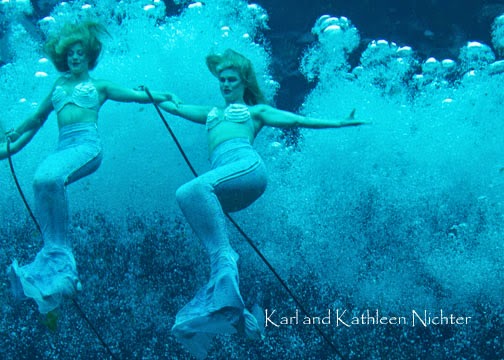
Florida: Weeki Wachee Mermaids
The small theatre with seats arranged in a semi-circle could
be anywhere. Then, the curtain goes up on the outside of what appears to be a
giant glass aquarium, and just inside the glass a wall of bubbles takes the
place of the curtain. As it clears, mermaids swim and dive in a beautifully
synchronized show, in this case, “The Little Mermaid”. Often fish and turtles
swim by, reminding you that this is an actual outdoor spring, not a staged set.
Since 1947 and continuing to this day the mermaids of Weeki Wachee entertain
tourists and locals. Today’s mermaids wear a tail, unlike the originals. Before
the mouse became synonymous with tourism in Florida, the natural springs
attracted people from all over the country, and people with vision transformed
springs into tourist attractions. Those springs attractions, usually
privately owned, gradually went out of business, their imperfect natural world
unable to complete with a fantasy destination. Recently a new generation of
visitors, looking for something different and perhaps even authentic, started
visiting the springs again for birding, nature walks, diving, swimming, and
entertainment. Florida is big enough to support both types of tourist
attractions.
W e visited Weeki Wachee, now a Florida State Park, in mid
January in preparation for our February book club meeting. Weeki Wachee Mermaids, Thirty
Years of Underwater Photography by Lu Vickers and Bonnie Georgiadis was our
selection for the month, and Bonnie herself often attended the book club
discussions. She is a wealth of information on historic Florida, and for many
years was a part of it as one of the mermaids of Weeki Wachee, then later
choreographing some of the shows. We all loved the book, and all the extra
tidbits told by her and her sisters. The book jacket shows a woman floating in
the water, not a mermaid! Several of those in the group, not realizing the
photo was not a person from the show, commented that there were a few other
photographs in the book that they felt would have made a better cover. As it
happens, the authors do not choose the cover, the publishers do. We enjoyed a
highly educational and enlightening view of Florida of the 50s and 60s from one
who lived it. I highly recommend this book as a visual history of Weeki Wachee
mermaids, and a fascinating story of how it came to be and what it was like to
be part of this still very popular Florida attraction.
A narrated boat ride down the river and back and animal
shows are included in the admission. The stars, of course, continue to be the
mermaids. Check the park schedule for the current shows.
Friday, February 13, 2015
Barberville Pioneer Settlement
This past spring we passed Barberville Pioneer Settlement on the way to a state park. Once settled in our site, I checked for information and found the times and days they opened to the public. On the way home, we made time to stop, and we are both glad we did.
Barberville Pioneer Settlement features a look at old Florida of the late 19th and early 20th century. Locally and regionally significant buildings were moved to the site, creating a snapshot of a small town of long ago. We took the self-guided tour, speaking to many of the costumed interpreters showing various skills once necessary to produce the items needed in everyday life, before a trip to the store accomplished the same. We did stop at the store/gift shop and purchased some of the items made by the volunteers when demonstrating their skills for visitors and school children, including a woven rug that sits just inside our sliding glass door at home.
We only had an hour or two for a visit, next time I would allow longer just so we could really look and linger.
Naturally we took photographs. Karl visualized this one in black and white before he shot, and it now graces our home gallery.
Barberville Pioneer Settlement features a look at old Florida of the late 19th and early 20th century. Locally and regionally significant buildings were moved to the site, creating a snapshot of a small town of long ago. We took the self-guided tour, speaking to many of the costumed interpreters showing various skills once necessary to produce the items needed in everyday life, before a trip to the store accomplished the same. We did stop at the store/gift shop and purchased some of the items made by the volunteers when demonstrating their skills for visitors and school children, including a woven rug that sits just inside our sliding glass door at home.
We only had an hour or two for a visit, next time I would allow longer just so we could really look and linger.
Naturally we took photographs. Karl visualized this one in black and white before he shot, and it now graces our home gallery.
Thursday, February 12, 2015
Photo Techniques: The Blur
When I started photography, way back in the film days, "tack sharp" dominated the criteria in judging a good photography. Minor blur suggesting motion occasionally found acceptance, but for the most part we looked for sharpness.
Lately in reading and watching videos of photographers I find blur in part of the photographs explained away as needed for showing motion, directing the eye to the sharp portion of the photograph, and in general as an OK part of the photograph. This comes from noted, long-time professional photographers.
On a recent hike I decided to see what I could do with blur. Upon my return to my office, I downloaded all the shots off the camera, and deleted all but one photograph. They looked out of focus, period.
This one I kept:
Everything came out sharp except the bird in motion, and even the bird in motion is clearly a bird.
I need a lot more practice, but for the record, here is the technique I used: I focused the lens on an area where a lot of bird activity centered. As activity shifted to that area, I shot. This is one of three of this particular bird.
"Fashion" changes in photography as well as everything else. Keeping up makes us better photographers.
Lately in reading and watching videos of photographers I find blur in part of the photographs explained away as needed for showing motion, directing the eye to the sharp portion of the photograph, and in general as an OK part of the photograph. This comes from noted, long-time professional photographers.
On a recent hike I decided to see what I could do with blur. Upon my return to my office, I downloaded all the shots off the camera, and deleted all but one photograph. They looked out of focus, period.
This one I kept:
Everything came out sharp except the bird in motion, and even the bird in motion is clearly a bird.
I need a lot more practice, but for the record, here is the technique I used: I focused the lens on an area where a lot of bird activity centered. As activity shifted to that area, I shot. This is one of three of this particular bird.
"Fashion" changes in photography as well as everything else. Keeping up makes us better photographers.
Friday, January 30, 2015
Field Journal: Birding at Brooker Creek Preserve
(Karl and I along with our team leader participate in a bird census at Brooker Creek Preserve. A research PhD at Brooker Creek developed this citizen science project almost 20 years ago in conjunction with an expert from the local Audubon group. It survived volunteers coming and going, research staff coming and going, budget cutbacks which reduced the routes counted, and countless other challenges, but still goes strong using the same methodology, and on two of the original four routes.)
Tuesday morning started dark and colder than expected. The drive to start our route, in an ATV with no windscreen, froze us before we counted the first bird. Luckily, no cloud cover meant the sunrise that greeted us when we arrived managed to thaw us out a bit.
Photography on these hikes primarily serves for identification purposes. The spotting of species of birds and counting is the purpose of the hike. I always carry my Canon 50D with the Canon 100 - 400 mm lens. All the shots are quick, hand-held, and usually at 400mm with me wishing for a bigger lens for the shot. Even the blurry, far less than perfect photographs often perform an important function. In addition to confirming a bird identification, they provide proof for some of the uncommon sightings we make and confirm them for the official records.
This morning started slow. The birds, obviously smarter than us, chose to wait until the sun began to warm the air and the insects began to move about. We counted 41 different species by the end of the hike. We also count number of individuals in each species. A juvenile Bald Eagle sat near the top of a tree, looking around for several minutes. We did see an adult too later in the hike further back on the route. Palm Warblers darted around everywhere, and American Robins flew overhead. We heard and saw many Sandhill Cranes.
I heard the call of the cranes getting closer, and looked up to find them directly overhead. Sometimes the best photographs are up.
We heard this White-eyed vireo before we saw it.
A Red-breasted Merganser swam in a pond with a group of Hooded Mergansers. The Hooded Mergansers are beautiful, but very skittish that morning. They remained on the far side of the pond and flew if approached at all. Even the 400 mm couldn't make a photo of them.
Tuesday morning started dark and colder than expected. The drive to start our route, in an ATV with no windscreen, froze us before we counted the first bird. Luckily, no cloud cover meant the sunrise that greeted us when we arrived managed to thaw us out a bit.
Photography on these hikes primarily serves for identification purposes. The spotting of species of birds and counting is the purpose of the hike. I always carry my Canon 50D with the Canon 100 - 400 mm lens. All the shots are quick, hand-held, and usually at 400mm with me wishing for a bigger lens for the shot. Even the blurry, far less than perfect photographs often perform an important function. In addition to confirming a bird identification, they provide proof for some of the uncommon sightings we make and confirm them for the official records.
This morning started slow. The birds, obviously smarter than us, chose to wait until the sun began to warm the air and the insects began to move about. We counted 41 different species by the end of the hike. We also count number of individuals in each species. A juvenile Bald Eagle sat near the top of a tree, looking around for several minutes. We did see an adult too later in the hike further back on the route. Palm Warblers darted around everywhere, and American Robins flew overhead. We heard and saw many Sandhill Cranes.
I heard the call of the cranes getting closer, and looked up to find them directly overhead. Sometimes the best photographs are up.
We heard this White-eyed vireo before we saw it.
A Red-breasted Merganser swam in a pond with a group of Hooded Mergansers. The Hooded Mergansers are beautiful, but very skittish that morning. They remained on the far side of the pond and flew if approached at all. Even the 400 mm couldn't make a photo of them.
Tuesday, January 27, 2015
Old Ways: Making Sugar Cane Syrup
According to the sources I read, sugar cane once grew in every county in Florida. Now, growing of cane and boiling it down to produce Pure Cane Syrup takes place for the most part at festivals showing the old ways of Florida.
Karl took this shot at a recent event. We watched them work for some time, and returned two days in a row, fascinated by the various parts of the process.
Monday, January 19, 2015
Red-shouldered Hawk at Brooker Creek Preserve
Red-shouldered Hawks frequently fly overhead and call at Brooker Creek Preserve (Tarpon Springs, FL). On a recent bird count (an 18 year and still running citizen science project at the preserve) we spotted this one directly overhead in a tree near the bridge over the main channel of the creek.
He flew to another tree next to the trail, and watched us as we walked by. I compared these photographs to both my desk version of Sibley Guide to Birds and the Peterson Hawks of North America. Based on those illustrations, and the bird's behavior, this appears to be a juvenile.
Subscribe to:
Posts (Atom)